Hi www
I'd like to share a few thoughts.. I originally came up with these ideas for Intel.. however, they could be applied to make the *perfect* graphics card..
Why does data need to travel around so much?.. storage to RAM.. to CPU to VRAM to..Why??
What if we had the entire system on a card? A card that could be plugged into any current PC?
Imagine with me..
Intel brings out a graphics card, the card has a 6c12t CPU.. a co-processor to compliment your Desktop's CPU. The card has an astonishing 2TB of storage which is also it's RAM/VRAM.. this is not just fantasy, I'm talking about permanence of data.. you may not know it but.. PCIE Drives are equally as fast as RAM. But I admit.. 1/3rd (15GB/s) the speed of conventional VRAM..but we must also consider that, we are reading direct from source..
It also invites the idea.. one protocol to rule them all.. PCIE. (yes yes USB too but.. not for this context).
By PCIE 5.0 the protocol will over take the mighty 45GB/s VRAM.. potentially being 128GB/s for PCIE 5.0.
Limited PCIE Lanes might have been a problem, however due to us having everything on the card.. its not a problem, the card can be designed specifically with internal PCIE lanes in mind.
For Intel this strategy yields great advantages.. a closed ecosystem (the card itself).. the Apple Mac is a great example of what you can do if you control the factors available, Apple make their operating system lighter than the hardware, and so they know how the system will perform.
The same could be true for Intel.. firstly they would have to give up those airs and graces on price to get mass adoption... however this is the perfect storm we are dreaming up so let's say they do it..
Intel make a higher end graphics processor, they include a decent CPU, they pressure chip manufacturers for PCIE 5.0, they pressure everyone to pretty much skip 4.0.. and price it around £700/$850/€850
Thinking on how they control their own card ecosystem, they would have to adhere to the most common API.. which is DirectX. There is no sense in trying to make your own API.. as we seen with Vulcan and AMD.. sure OpenGL was great for a while and even outstripped DX but that was while Microsoft was dragging its heels for Xbox 360 and DX9. The smartest way to do business would be just to accept DX as~is.. and take every line of its code and make hardware that runs it so smoothly.. it becomes more than hardware running code... it becomes a lover reciting poetry..I'm going a bit left field here with the refs.. but that's why I left blogging on OCN.. well, one of the reasons.
Think of the card like this.. DX is like it's OS, as its CPU would be specifically designed to run DX code, it *can* run normal code just like any co-processor but its best at running DX.. as it's also a storage device, it has all the data ready for gaming.
It struck me that the system I have described isn't entirely a closed system.. as DX is by Microsoft and Intel couldn't change the code to suit their hardware, but it's not all one way, as Intel could lobby Microsoft for features and code that they wished in the long run.
Intel *could* with MS's permission make a DX derivative, but that would mean convincing publishers.. and then you are back in a situation like AMD and Vulcan.
No what is clean is.. knowing DX 'chapter & small print' and making custom hardware solution solely to run that code like butter. Like loose leafs of paper are caught by the wind.. think of each one with a drawing upon it, these are the textures.
CPU & GPU & Storage; in perfect harmony.
Dava
-----------
Refs:
Speed
*http://blog.logicalincrements.com/2018/08/data-transfer-rates-bandwidth-cpu-ram-pcie-m-2-sata-usb-hdmi/
Speed
*
https://www.pcworld.com/article/3400176/pcie-40-everything-you-need-to-know-specs-compatibility.html
Tuesday, 21 April 2020

Dava's Tenets of Basic Common Sense in game design.. or too many no-no's don't make a yes-yes!
Hi WWW
Here are some Cardinal Rules of game design:
Rule 1:
Don't mess with people's saves. EVER.
Rule 2:
Don't put an invisible walls anywhere inside the sandbox. to cage us inside is fine. But once inside; it is OUR PLAYGROUND.. no longer yours. .. stop picking at it.
Rule 3:
Intuitive control.. beg, borrow.. steal if you have to from other Devs and Dev publishers.. the middle tool is so vastly unimportant, that you, Dev, sweating about it, isn't helping! If a control method is popular use that instead.
Rule 4:
Let us skip EVERYTHING.. cutscenes, cinematics, intro movies (I am aware I own a Nvidia graphics card, no need to waste my time showing me a mini movie about it).
Rule 5:
Don't put things in the game I could mistake as a 'glitch'. Seriously.
Rule 6:
If I have near completed a quest and the final part fails .. not due to me misunderstanding what to do.. but the game did not allow me to do it; ensure you have checkpoints. If the game failed and not me.. that was your problem not mine.. so to stop any arguments between player and Dev.. have checkpoints while the mission is active.. if the player quits; they must *then* and *only then*.. have to restart the whole mission if it is not completed.
Rule 7:
All bugs MUST GO. Even if your game is 20 years old.. if you are making coin off the franchise and a bug is reported. fix it!
Break any of these rules and you are a BAD DEVELOPER.. it's like being a bad parent but instead of disappointing a handful of kids.. disappointing 10's of thousands of people in one go.
@Publishers
Have a 'Gamma Team'.. who are much like Beta Testers in reverse. Gamma 'Testers'.. small team that covers all franchised games, that make coin for you as a publisher. Team of 5 to 10 people.. like a dead letter office of games publishing. You send annoyed or concerned players to them instead of your media team having to deal with an old game.
Dava
-----
I *may* come back and update this with more.. but that's enough for now.
I would like to thank Ubisoft for inspiring this list.. FLIP!! It's just basic common courtesy.. don't mess with peoples save games! FC5-DLC. Whoever thought it was a good idea over at Ubisoft.. well they probably deserve all the twitter hate the Ubi media team had to deal with and I hope they passed that along to that person.. as 'feedback/suggestions'. I am sure other players had some suggestions what that Dev could do with the game!
Here are some Cardinal Rules of game design:
Rule 1:
Don't mess with people's saves. EVER.
Rule 2:
Don't put an invisible walls anywhere inside the sandbox. to cage us inside is fine. But once inside; it is OUR PLAYGROUND.. no longer yours. .. stop picking at it.
Rule 3:
Intuitive control.. beg, borrow.. steal if you have to from other Devs and Dev publishers.. the middle tool is so vastly unimportant, that you, Dev, sweating about it, isn't helping! If a control method is popular use that instead.
Rule 4:
Let us skip EVERYTHING.. cutscenes, cinematics, intro movies (I am aware I own a Nvidia graphics card, no need to waste my time showing me a mini movie about it).
Rule 5:
Don't put things in the game I could mistake as a 'glitch'. Seriously.
Rule 6:
If I have near completed a quest and the final part fails .. not due to me misunderstanding what to do.. but the game did not allow me to do it; ensure you have checkpoints. If the game failed and not me.. that was your problem not mine.. so to stop any arguments between player and Dev.. have checkpoints while the mission is active.. if the player quits; they must *then* and *only then*.. have to restart the whole mission if it is not completed.
Rule 7:
All bugs MUST GO. Even if your game is 20 years old.. if you are making coin off the franchise and a bug is reported. fix it!
Break any of these rules and you are a BAD DEVELOPER.. it's like being a bad parent but instead of disappointing a handful of kids.. disappointing 10's of thousands of people in one go.
@Publishers
Have a 'Gamma Team'.. who are much like Beta Testers in reverse. Gamma 'Testers'.. small team that covers all franchised games, that make coin for you as a publisher. Team of 5 to 10 people.. like a dead letter office of games publishing. You send annoyed or concerned players to them instead of your media team having to deal with an old game.
Dava
-----
I *may* come back and update this with more.. but that's enough for now.
I would like to thank Ubisoft for inspiring this list.. FLIP!! It's just basic common courtesy.. don't mess with peoples save games! FC5-DLC. Whoever thought it was a good idea over at Ubisoft.. well they probably deserve all the twitter hate the Ubi media team had to deal with and I hope they passed that along to that person.. as 'feedback/suggestions'. I am sure other players had some suggestions what that Dev could do with the game!
Monday, 9 March 2020
The PCIE Lanes famine..or High Performance vs Drastically Reduced Functionality
Hi www
Today an amazing deal for a Ryzen came up. Less than half price!.. wow.. and then I thought.. 'wait don't newer CPU's have like no lanes?? (20 lanes) What does that mean for my many PCIE drives??..no, I don't have enough reason spend a fortune on a new rig, the rig I have (HP workstation) is more than capable and isn't PCIE gimped.'
Going forward we should even MORE lanes not less.. my dual X5650.. give 56 lanes EACH. Admittedly they are PCIE gen 2.. but.. 112 lanes of gen 2 vs 20 of gen3 or even 4.. nope.
This encourages me to do the unthinkable.. to recommend to people old tech.
I don't need the thing to be a server but I need the ability to have as many drives as I would like in the machine.
Let's face it.. if it's not PCIE its not the fastest possible speed. So it follows that all internal components should be PCIE to give us the fast possible performance.
Why do we need other busses in this day and age? What advantage does SATA have over PCIE?.. and even USB.. I DO think we should keep USB devices.. but couldn't the next new standard be a reworking of PCIE? For speed purposes only.. not the 75w requirement!
What can I get from on board busses that I couldn't get from a separate card of the same type?
To do as I suggest..we need 60 to 100+ lanes and 20 physical slots (at least 20 physical slots) each of the first four double spaced away from each other so no overlap. After that as tight as you like. These would be.. as I would dub them.. EXL-ATX boards and be near double the length of a ATX.. They would need fasteners at the side of the board for the lower 16 physical slots.. as the peripherals would be expected to be internal *only*..
I digress..
I don't why this isn't happening already.. but again I am bemused when case manufacturers don't work out a way to do vertical cases and insist on horizontal. The air wants to escape upwards anyway, why push it elsewhere?.. you would need a splash guard yes, but any decent fans would be able to be a splash guard anyway.
I digress .. again.. sorry..
We don't NEED all this new fancy hardware.. we have already reached a comfortable stage, however if the is .. IF THERE is to be new hardware, we should be designing it with the future in mind, not building in absurd obsolescence.
Dava
Today an amazing deal for a Ryzen came up. Less than half price!.. wow.. and then I thought.. 'wait don't newer CPU's have like no lanes?? (20 lanes) What does that mean for my many PCIE drives??..no, I don't have enough reason spend a fortune on a new rig, the rig I have (HP workstation) is more than capable and isn't PCIE gimped.'
Going forward we should even MORE lanes not less.. my dual X5650.. give 56 lanes EACH. Admittedly they are PCIE gen 2.. but.. 112 lanes of gen 2 vs 20 of gen3 or even 4.. nope.
This encourages me to do the unthinkable.. to recommend to people old tech.
I don't need the thing to be a server but I need the ability to have as many drives as I would like in the machine.
Let's face it.. if it's not PCIE its not the fastest possible speed. So it follows that all internal components should be PCIE to give us the fast possible performance.
Why do we need other busses in this day and age? What advantage does SATA have over PCIE?.. and even USB.. I DO think we should keep USB devices.. but couldn't the next new standard be a reworking of PCIE? For speed purposes only.. not the 75w requirement!
What can I get from on board busses that I couldn't get from a separate card of the same type?
To do as I suggest..we need 60 to 100+ lanes and 20 physical slots (at least 20 physical slots) each of the first four double spaced away from each other so no overlap. After that as tight as you like. These would be.. as I would dub them.. EXL-ATX boards and be near double the length of a ATX.. They would need fasteners at the side of the board for the lower 16 physical slots.. as the peripherals would be expected to be internal *only*..
I digress..
I don't why this isn't happening already.. but again I am bemused when case manufacturers don't work out a way to do vertical cases and insist on horizontal. The air wants to escape upwards anyway, why push it elsewhere?.. you would need a splash guard yes, but any decent fans would be able to be a splash guard anyway.
I digress .. again.. sorry..
We don't NEED all this new fancy hardware.. we have already reached a comfortable stage, however if the is .. IF THERE is to be new hardware, we should be designing it with the future in mind, not building in absurd obsolescence.
Dava
Sunday, 29 December 2019
Intel Discrete Graphics Cards.. my take on what would be beneficial to the community and Intel
Hi www
So over much time, I have been thinking about Intel graphics cards since before Intel themselves took it seriously..
In short.. Intel need to build a consumer-ship from scratch, and on every side they have the potential to be squeezed out of the market.
So with that in mind, I have some.. recommendations for the Intel Graphics Department..
1. you need a catchy name for your cards that has nothing to do with your other products.. you already have 'Optaine'.. perhaps 'nitro' ? 'Intel Nitro Graphics Cards'.. it makes it stand out as its own thing, if you just called it Optaine, then it's likely to get drowned when people search for info and pricing when shopping for one..
2. Sad but true.. it'll have to be a mid range graphics card.. just throwing out some lowend thing is not very smart, or trying to compete with the ultra high end is equally not as smart..
a.on the low end the market is full of both new and second hand cards that are more than capable
b. on the high end your drivers and driver Devs need time to mature and handle games better, just throwing a load of power at something doesn't translate well to 'good gaming' just ask AMD who have had endless woes with their drivers.
What imho Intel needs to do is put out something.. around 2000 shader cores.. seeing its Intel.. 2048 shader cores because its nerdy :)) 120 TMU 64 ROUs with 12GB of GDDR6 .. but with a pleasant caveat I'll come to in a moment.
So over much time, I have been thinking about Intel graphics cards since before Intel themselves took it seriously..
In short.. Intel need to build a consumer-ship from scratch, and on every side they have the potential to be squeezed out of the market.
So with that in mind, I have some.. recommendations for the Intel Graphics Department..
1. you need a catchy name for your cards that has nothing to do with your other products.. you already have 'Optaine'.. perhaps 'nitro' ? 'Intel Nitro Graphics Cards'.. it makes it stand out as its own thing, if you just called it Optaine, then it's likely to get drowned when people search for info and pricing when shopping for one..
2. Sad but true.. it'll have to be a mid range graphics card.. just throwing out some lowend thing is not very smart, or trying to compete with the ultra high end is equally not as smart..
a.on the low end the market is full of both new and second hand cards that are more than capable
b. on the high end your drivers and driver Devs need time to mature and handle games better, just throwing a load of power at something doesn't translate well to 'good gaming' just ask AMD who have had endless woes with their drivers.
What imho Intel needs to do is put out something.. around 2000 shader cores.. seeing its Intel.. 2048 shader cores because its nerdy :)) 120 TMU 64 ROUs with 12GB of GDDR6 .. but with a pleasant caveat I'll come to in a moment.
(update 31/May/2022 : 6144 shader cores, 384 TMU, 194 ROUs, 48 RTC with 16GB GDDR6 for mid level, £/$200.. top level, double the above: 12288 shader codes, 768 TMU, 184 ROUs, 92 RTC with 24 to 32 GB GDDR6 £/$400 )
Why have the media/game data in a separate device? Why not throw an integrated 1TB-4TB stick of PCIE Optaine as part of the graphics card? Direct on the PCB, with Optaine chips specially designed not to be Graphics RAM, but as fast as Graphics RAM.. how? .. I would suggest that the card has its own PCIE bus lanes and mini CPU.. 'system on card' but with the entire purpose of creating graphics. Some easier parts could be sent to the mini-CPU (2c/4t Low Power cores recommended) and anything that required heavy lifting could be sent to the mainboard CPU.
Imagine those with weak CPUs.. they could buy your card without the worry of getting the worst possible performance if their CPU is pants.. as some of what is done will go to the on-card mini-CPU.
All those people who want an easy life.. plug in and play, if they have an old desktop with 2 cores but its all they have, they could buy your card and job done. Dad or Moms work PC? this card = job done just by plugging it in.
Even perhaps cards that have no need for VRam.. but read and process the data directly, from storage from the 'system on card'.
3. It is has to be CHEAP.. unfortunately for you, you can't go the expensive route.. because you don't have driver confidence, and imho that will take 5 to 10 years of successful products including the drivers themselves.
NV is an excellent example of what a company can do if they pay attentions to gamers needs and put much effort in the features of their interface (NVCP). Not being able to make custom res's is a deal breaker for me.. something small like that even can make life just that bit nicer.
But NV isn't perfect.. oh they are the best in the business.. but still they have driver problems with each release.
And so with that explained.. Intel is new, doesn't matter your rep in the CPU market, this is GPUs and here its cut throat.. and its been mostly NV doing the cutting of the throats.
Being new means.. you need a competent product that is not irrelevant due to other companies offerings. You NEED to offer much more value for money than either competitor.. or AMD will swallow your marketshare whole.
So I suggest putting out the above card for around $250-300/£250-300. (update May 2022:mid level £/$200)
Yes you will make a loss.. but you are buying customers loyalty in the hopes they try>enjoy>recommend.
Don't worry NV has done this before to when they hit a slump or messed up so badly everyone started talking about jumping ship to AMD..
What place is there in the market for Intel?
To begin with.. not much, however if you can beat AMD on price vs performance AND have competent drivers with decent features.. releasing a new card every two years (four years for new refresh).. ohw maybe need to explain this..
Every two years GPU manufacturers release 'new' cards.. they take the higher cards from their previous line and rebrand them as mid level cards while they get ready for totally new cards in two years.. so for Intel you would be starting with a blank slate and potentially only one or two cards so you couldn't do it this way until you had 6-8 years under your belt..but you could do an initial release and then 'beef up' the cards specs.. all the time in the interim tightening the drivers with feedback from customers..
Flip! no one will tell you this, but customer feedback is an essential component of GPU production.. because IF you listen to their feedback.. however obnoxious or nasty.. they may have a grain of truth in what they are trying to say.
Look at AMD.. ignores its customer feedback, drivers are usually awful. So they end up just throwing power at it and hope it works. That's not a good way to keep your fans.
For CPUs I was an AMD guy for many years, I used NV for Graphics cards.. I tried the AMD + AMD thing.. welp doesn't work if your drivers are nonsense. I bought a HP Workstation after a water incident.. with my twin Xeon X5650s (at the time of writing*) and am happy with them. I also rock a NV 2080ti.. but I'm not your target customer base just yet.. people who can afford this stuff will buy NV. They aren't coming over to be the test rabbits for your experiment..
Aim too high and no one will care. Aim too low and no one will care. Harsh but I imagine no one else will tell you this stuff.. and by the amount I have written.. I think you can see I have hopes for you in this marketspace, Intel.
I digress..
Why have the media/game data in a separate device? Why not throw an integrated 1TB-4TB stick of PCIE Optaine as part of the graphics card? Direct on the PCB, with Optaine chips specially designed not to be Graphics RAM, but as fast as Graphics RAM.. how? .. I would suggest that the card has its own PCIE bus lanes and mini CPU.. 'system on card' but with the entire purpose of creating graphics. Some easier parts could be sent to the mini-CPU (2c/4t Low Power cores recommended) and anything that required heavy lifting could be sent to the mainboard CPU.
Imagine those with weak CPUs.. they could buy your card without the worry of getting the worst possible performance if their CPU is pants.. as some of what is done will go to the on-card mini-CPU.
All those people who want an easy life.. plug in and play, if they have an old desktop with 2 cores but its all they have, they could buy your card and job done. Dad or Moms work PC? this card = job done just by plugging it in.
Even perhaps cards that have no need for VRam.. but read and process the data directly, from storage from the 'system on card'.
3. It is has to be CHEAP.. unfortunately for you, you can't go the expensive route.. because you don't have driver confidence, and imho that will take 5 to 10 years of successful products including the drivers themselves.
NV is an excellent example of what a company can do if they pay attentions to gamers needs and put much effort in the features of their interface (NVCP). Not being able to make custom res's is a deal breaker for me.. something small like that even can make life just that bit nicer.
But NV isn't perfect.. oh they are the best in the business.. but still they have driver problems with each release.
And so with that explained.. Intel is new, doesn't matter your rep in the CPU market, this is GPUs and here its cut throat.. and its been mostly NV doing the cutting of the throats.
Being new means.. you need a competent product that is not irrelevant due to other companies offerings. You NEED to offer much more value for money than either competitor.. or AMD will swallow your marketshare whole.
So I suggest putting out the above card for around $250-300/£250-300. (update May 2022:mid level £/$200)
Yes you will make a loss.. but you are buying customers loyalty in the hopes they try>enjoy>recommend.
Don't worry NV has done this before to when they hit a slump or messed up so badly everyone started talking about jumping ship to AMD..
What place is there in the market for Intel?
To begin with.. not much, however if you can beat AMD on price vs performance AND have competent drivers with decent features.. releasing a new card every two years (four years for new refresh).. ohw maybe need to explain this..
Every two years GPU manufacturers release 'new' cards.. they take the higher cards from their previous line and rebrand them as mid level cards while they get ready for totally new cards in two years.. so for Intel you would be starting with a blank slate and potentially only one or two cards so you couldn't do it this way until you had 6-8 years under your belt..but you could do an initial release and then 'beef up' the cards specs.. all the time in the interim tightening the drivers with feedback from customers..
Flip! no one will tell you this, but customer feedback is an essential component of GPU production.. because IF you listen to their feedback.. however obnoxious or nasty.. they may have a grain of truth in what they are trying to say.
Look at AMD.. ignores its customer feedback, drivers are usually awful. So they end up just throwing power at it and hope it works. That's not a good way to keep your fans.
For CPUs I was an AMD guy for many years, I used NV for Graphics cards.. I tried the AMD + AMD thing.. welp doesn't work if your drivers are nonsense. I bought a HP Workstation after a water incident.. with my twin Xeon X5650s (at the time of writing*) and am happy with them. I also rock a NV 2080ti.. but I'm not your target customer base just yet.. people who can afford this stuff will buy NV. They aren't coming over to be the test rabbits for your experiment..
Aim too high and no one will care. Aim too low and no one will care. Harsh but I imagine no one else will tell you this stuff.. and by the amount I have written.. I think you can see I have hopes for you in this marketspace, Intel.
I digress..
What place is there in the market for Intel?
To begin with.. not much, however if you can beat AMD on price vs performance AND have competent drivers with decent features.. releasing a new card every two years (four years for new refresh)..increasing your performance 10-20% every four years for the same amount of money for the same price point.
This is where Intel could snuggly fit into the market.. getting enough press about the gaming performance itself to salivate consumer appetites, all free press garnering curiosity and interest.. but something deeper.. prestige that people can tell other people they own one and have a conversation about owning one.. maybe I'm over stating it..yes I am but its illustrative of something Intel has NEVER needed to do.
Create a userbase and brand recognition from scratch.
Dava
To begin with.. not much, however if you can beat AMD on price vs performance AND have competent drivers with decent features.. releasing a new card every two years (four years for new refresh)..increasing your performance 10-20% every four years for the same amount of money for the same price point.
This is where Intel could snuggly fit into the market.. getting enough press about the gaming performance itself to salivate consumer appetites, all free press garnering curiosity and interest.. but something deeper.. prestige that people can tell other people they own one and have a conversation about owning one.. maybe I'm over stating it..yes I am but its illustrative of something Intel has NEVER needed to do.
Create a userbase and brand recognition from scratch.
Dava
------------
* Now I have a HP Z840 twin Xeon E5-2660v3's 20c/40t, DDR4-2133 32GB, 2080Ti, load of PCIE and SSD and couple of HDD, totalling idk 15TB? 4K TV and a small HP 900p monitor.
Old set up was.. twin Xeon X5650, 48GB of DDR3 1066, 2018ti/1070 and drives/monitors as above.
Sunday, 31 March 2019
Drive Capacities the return.. or a drive is a drive of course of course except of course when they are the famous mister RAID
----------------------------
Hi guys
Firstly please read my complaint of drive manufacturers laziness here:
https://ftr-ceu.blogspot.com/2018/08/ssd-and-drive-capacities-or-king-has-no.html
Q: What stops drive manufacturers putting multi layered PCB multi slot cards of M.2 (M Key) drives?
A: nothing..
The PCIE specification can default to the appropriate maximum speed, now while I do not recommend putting one of these hypothetical drives into a PCIE-1 x1.. it is much more common to have higher speeds.. even at a x16 PCIE-1 that's 250MB/s for 8 drives..but let's take a typical scenario;
Scenario 1
PCI-E 3/four slots of x16
15.8 GB/s
each PCB would have four 1TB drives in Raid JBOD (spanned)
Four PCBs would mean 750MB/s - upto 1GB/s per PCB (still being double the SSD speed)
total: 16 Terabyte
RAID 0 Speed: upto 12GB/s
Suggested price point: £100/$130
each PCB shows up as a separate disk, which you can choose to software JBOD or RAID 0, using RAID 0 theoretically (if the RAID controller on the PCB is any good), usual max speeds are 3GB/s x four would be upto 12GB/s in RAID 0 for the entire drive.
-----
Scenario 2
PCI-E 4/four slots of x16
31.5GB/s
each PCB would have four 1TB drives in Raid JBOD (spanned)
Four PCBs would mean upto 7.8GB/s per PCB.
total: 16 Terabyte
-----
Scenario 3
PCI-E 5/four slots of x16
63GB/s
each PCB would have four 1TB drives in Raid JBOD (spanned)
Four PCBs would mean upto 15.75GB/s per PCB.
total: 16 Terabyte
Scenario 8
192 Terabyte : Suggested price point: £1500/$1800
Hi guys
Firstly please read my complaint of drive manufacturers laziness here:
https://ftr-ceu.blogspot.com/2018/08/ssd-and-drive-capacities-or-king-has-no.html
Q: What stops drive manufacturers putting multi layered PCB multi slot cards of M.2 (M Key) drives?
A: nothing..
The PCIE specification can default to the appropriate maximum speed, now while I do not recommend putting one of these hypothetical drives into a PCIE-1 x1.. it is much more common to have higher speeds.. even at a x16 PCIE-1 that's 250MB/s for 8 drives..but let's take a typical scenario;
Scenario 1
PCI-E 3/four slots of x16
15.8 GB/s
each PCB would have four 1TB drives in Raid JBOD (spanned)
Four PCBs would mean 750MB/s - upto 1GB/s per PCB (still being double the SSD speed)
total: 16 Terabyte
RAID 0 Speed: upto 12GB/s
Suggested price point: £100/$130
each PCB shows up as a separate disk, which you can choose to software JBOD or RAID 0, using RAID 0 theoretically (if the RAID controller on the PCB is any good), usual max speeds are 3GB/s x four would be upto 12GB/s in RAID 0 for the entire drive.
-----
Scenario 2
PCI-E 4/four slots of x16
31.5GB/s
each PCB would have four 1TB drives in Raid JBOD (spanned)
Four PCBs would mean upto 7.8GB/s per PCB.
total: 16 Terabyte
RAID 0 Speed: upto 23.6GB/s
-----
Scenario 3
PCI-E 5/four slots of x16
63GB/s
each PCB would have four 1TB drives in Raid JBOD (spanned)
Four PCBs would mean upto 15.75GB/s per PCB.
total: 16 Terabyte
RAID 0 Speed: upto 47.25GB/s
-----
Scenario 4
PCI-E 4/four slots of x16
31.5GB/s
each PCB would have eight 1TB drives in Raid JBOD (spanned)
Four PCBs would mean upto 3.9GB/s per PCB.
total: 32 Terabyte
PCI-E 4/four slots of x16
31.5GB/s
each PCB would have eight 1TB drives in Raid JBOD (spanned)
Four PCBs would mean upto 3.9GB/s per PCB.
total: 32 Terabyte
RAID 0 Speed: upto 23.6GB/s
Suggested price point: £230/$280
-----
Scenario 5
PCI-E 5/four slots of x16
63GB/s
each PCB would have eight 1TB drives in Raid JBOD (spanned)
Four PCBs would mean upto 7.8GB/s per PCB.
total: 32 Terabyte
PCI-E 5/four slots of x16
63GB/s
each PCB would have eight 1TB drives in Raid JBOD (spanned)
Four PCBs would mean upto 7.8GB/s per PCB.
total: 32 Terabyte
RAID 0 Speed: upto 47.25GB/s
-----
Scenario 6
PCI-E 4/four slots of x16
31.5GB/s
each PCB would have eight 2TB drives in Raid JBOD (spanned)
Four PCBs would mean upto 3.9GB/s per PCB.
total: 64 Terabyte
31.5GB/s
each PCB would have eight 2TB drives in Raid JBOD (spanned)
Four PCBs would mean upto 3.9GB/s per PCB.
total: 64 Terabyte
RAID 0 Speed: upto 23.6GB/s
Suggested price point: £450/$500
------
Scenario 7
PCI-E 5/four slots of x16
63GB/s
each PCB would have eight 2TB drives in Raid JBOD (spanned)
Four PCBs would mean upto 7.8GB/s per PCB.
total: 64 Terabyte
PCI-E 5/four slots of x16
63GB/s
each PCB would have eight 2TB drives in Raid JBOD (spanned)
Four PCBs would mean upto 7.8GB/s per PCB.
total: 64 Terabyte
RAID 0 Speed: upto 47.25GB/s
------
Scenario 8
PCI-E 4/four slots of x16
31.5GB/s
each PCB would have twelve 2TB drives in Raid JBOD (spanned)
Four PCBs would mean upto 1.95GB/s per PCB.
total: 96 Terabyte
31.5GB/s
each PCB would have twelve 2TB drives in Raid JBOD (spanned)
Four PCBs would mean upto 1.95GB/s per PCB.
total: 96 Terabyte
RAID 0 Speed: upto 7.8GB/s
Suggested price point: £750/$900
------
Scenario 9
PCI-E 5/four slots of x16
63GB/s
each PCB would have twelve 2TB drives in Raid JBOD (spanned)
Four PCBs would mean upto 3.9GB/s per PCB.
total: 96 Terabyte
PCI-E 5/four slots of x16
63GB/s
each PCB would have twelve 2TB drives in Raid JBOD (spanned)
Four PCBs would mean upto 3.9GB/s per PCB.
total: 96 Terabyte
RAID 0 Speed: upto 15.6GB/s
------
Scenario 10 (industrial)
PCI-E 5/four slots of x16
63GB/s
each PCB would have twelve 4TB drives in Raid JBOD (spanned)
Four PCBs would mean upto 3.9GB/s per PCB.
total: 192 Terabyte
PCI-E 5/four slots of x16
63GB/s
each PCB would have twelve 4TB drives in Raid JBOD (spanned)
Four PCBs would mean upto 3.9GB/s per PCB.
total: 192 Terabyte
RAID 0 Speed: upto 15.6GB/s
192 Terabyte : Suggested price point: £1500/$1800
192 Terabyte : Suggested price point: £1500/$1800
Inside the drive would be: a very slim riser with four slots, one for each Slave PCB, each would be x16 mechanically but through the onboard chip, each would be x4 electrically.
On the industrial drives, they have splitters to increase speeds:
A double sided PCIE Gold Connecter Master PCB, the splitter simply joins to the other side of the PCIE Connecter, then the end of splitter has multiple ends which fit into the various motherboard PCIE slots.
On the industrial drives, they have splitters to increase speeds:
A double sided PCIE Gold Connecter Master PCB, the splitter simply joins to the other side of the PCIE Connecter, then the end of splitter has multiple ends which fit into the various motherboard PCIE slots.
Price points grouped:
16 Terabyte : Suggested price point: £100/$130
32 Terabyte : Suggested price point: £230/$280
64 Terabyte : Suggested price point: £450/$500
96 Terabyte : Suggested price point: £750/$900
192 Terabyte : Suggested price point: £1500/$1800
::RANT> ::
OR Drive Manf.'s can sit there and let users drown in drive management problems, not doing their job in this industry. Failing all consumers.To drag out mechanical drives for profit.
Remember its regularly 50GB A GAME! 1TB is filled by 20 games!!!
FAIL FAIL FAIL.
It's the same chips that are on SSDs using the SATA bus.. SATA is dead, only good for Optical Drives for ripping old discs.. long live the King PCIE!!
It's the same chips that are on SSDs using the SATA bus.. SATA is dead, only good for Optical Drives for ripping old discs.. long live the King PCIE!!
:: <RANT::
Sorry, its not EVERY company, but it just burns me to think of certain drive manufacturers sitting back and letting the cash roll in.. to the frustration of their customers.
Monday, 4 March 2019
Refresh Rates CheatSheet for 4K TVs

Hi
Time to dump a load of info here:
Increased Refresh Increased Resolution
---------------------- --------------------------
4K/60hz = 4K/60hz =
1080 @ 240hz 3200x2400 @ 72hz*
-2K- 3840x2400 @ 60hz
1536 @ 162hz 4096x2560 @ 55hz
1440 @ 144hz 5120x2160 @ 50hz
-3K- 5120x2560 @ 44hz
1800 @ 94hz 6120x1900 @ 50hz
2048 @ 72hz* 6120x2160 @ 40hz
6120x2560 @ 35hz
All used NVCP. All used CVT Reduced Blank. on my Philips 4K 58" HDR TV (HDR was of course off). No Down or upsampling was used for the above resolutions, however in the pictures I think? I still had two test down sampled resolutions, but 95% of the ones in the pics are all active pixels.
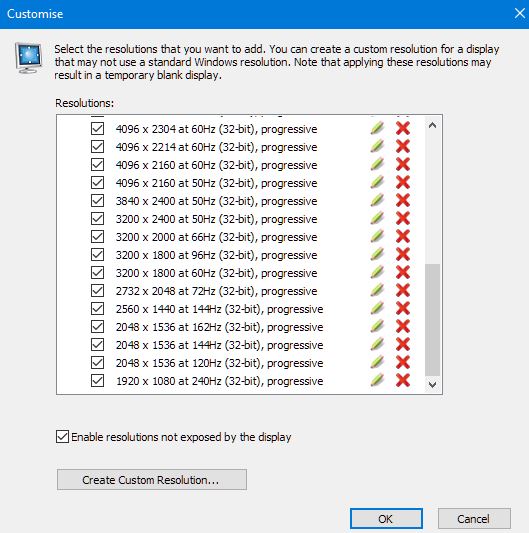


To show all pixels were active:

------------------
Use this info at your own risk.
*3641x2048 = 16:9 for 2048p
*3K pix, but 2400 wider so 72hz.
-------------------
Big shoutout to those who helped me no end with their work and websites:
ARC Aspect Ratio Calculator
https://andrew.hedges.name/experiments/aspect_ratio/
Good place to start learning:
https://en.wikipedia.org/wiki/List_of_common_resolutions
https://www.unravel.com.au/aspect-ratio-cheat-sheet
16:9 Cheat Sheet:
https://pacoup.com/2011/06/12/list-of-true-169-resolutions/comment-page-1/
few decent 5K's (but rest a bit old/depreciated):
http://blog.chameleondg.com/post/111891072017/resolution-aspect-ratio-cheat-sheet
General Approximations of Terms:
2 million pix. = 1K commonly; 1920x1080
3 to 4 million pix = 2K commonly; 2048x1536 and 2560x1440
5 to 7 million pix = 3K commonly; 3200x1800
8 to 10 million pix = 4K commonly; 4096x2160
11 to 20 mil. pix = 5K commonly; 5120x2160, 5120x2880
20 to 30 mil. pix = 6K commonly; 6400x4096
30 mil. to 36 mil pix = 7K commonly; 7680x4320
37 mil. pix is 8K don't get sucked into the 7K as 8K nonsense, 8192x4608 is *true* 8K. It comes from 8 for the first digit.
4K TV =
(2 million pix.) = 1K //// 244hz
(3 to 4 million pix( = 2K //// 162hz
(5 to 7 million pix) = 3K //// 144hz
(8 to 10 million pix) = 4K //// 60hz
(11 to 20 mil. pix) = 5K //// 50hz
(20 to 30 mil. pix) = 6K //// 40hz
(30 mil. to 36 mil pix) = 7K //// 30hz?
37 mil. pix is = 8K //// 20hz?
above is a rough guide to ?K x 2K
But the higher the V-Res, the harder it hits the refresh rate.. asin~
6K x 2K has a baseline of 40hz but
6K x 3K, 6144x3456 overall is 27hz max. clean.
This is because.. well.. idk.. but I strongly suspect it has something to do with the reason V-Sync uses vertical refresh and not horizontal.
My panel in 1K did 243 because 244hz gave me a bit of wobble.. but since 240 is 100% stable and the refresh so high, I don't want to argue over a couple of hz.
Sunday, 25 November 2018
Fallout 76.. A Game of Woes..or how can FO76 be fixed?
Hi WWW
Back in March I wrote an article about how Zenimax could maximise profits:
https://ftr-ceu.blogspot.com/2018/03/a-second-tier-or-why-zenimax-should.html
I see they *may* have took my advice, however when it's ES or FO.. people come FOR the story, not despite it.
FO76 is a FO themed Rust clone without PVP.
Crazy huh?
IF FO76 was a FO themed Borderlands jump in co-op style game.. that would make sense.
An EPIC story you could play with friends, every 6 months launching a new episode, with new (NV sized) lands, new bad guys/huge bosses and new story.
BUT surprisingly, I say.. this *can* be fixed!
Please, kindly.. do what I suggest in the original article.. hire Obsidian and/or Chris Avellone, give them half the cash to fix the game, introducing a new storyline.. idk.. a new huge boss threatens the land.. Chris could work it out, I'm just riffing.
First episode is free if you already own the game, then every 6 months new episode done by Obsidian, split the cash 50/50.
OR
Do nothing.
Be resigned having your studio's name in the bargain bin.
Watch future title sales plummet.
Be Sega in the 90s.
(quite famously.. Sega didn't care what fans thought of them and pumped fans wallets for irrelevant hardware.. by 2002 they had ended their hardware division)
I am shrewd enough to guess this was a port of the old studios game that was almost canned due to Dev purgatory.. and that the game was whipped up from 6 months work.
I don't have a problem with that. It's smart to recycle assets to minimise profit loss .. but Zenimax.. guys you missed the things I bulletended most about FO
"The years on these assets seem to be rolling by, with it being over 2 years since Bethesda release Fallout 4. As I said.. that's 2 years without them making any 'new' money. Ultimately when a game becomes a gamers 'main game' what they are usually looking for is;
1. plenty of content.
2. an excellent story.
3. excitement with occasional comedy."
FO76 has:
1. Very little content.
2. No story, aside from lore.
3. a bug every 5 minutes.
I have finished any rebuke I have for you, Bethesda/Zenimax..
You are now responsible for fixing this game. Give it to Obsidian/Chris Avellone.. roll huge trucks of cash up to their front door and say.. 'please fix this'. Because people.. they wanted a Fallout game with a co-op flavor ala ~ Borderlands, not a non-PVP Rust clone.
peace
Back in March I wrote an article about how Zenimax could maximise profits:
https://ftr-ceu.blogspot.com/2018/03/a-second-tier-or-why-zenimax-should.html
I see they *may* have took my advice, however when it's ES or FO.. people come FOR the story, not despite it.
FO76 is a FO themed Rust clone without PVP.
Crazy huh?
IF FO76 was a FO themed Borderlands jump in co-op style game.. that would make sense.
An EPIC story you could play with friends, every 6 months launching a new episode, with new (NV sized) lands, new bad guys/huge bosses and new story.
BUT surprisingly, I say.. this *can* be fixed!
Please, kindly.. do what I suggest in the original article.. hire Obsidian and/or Chris Avellone, give them half the cash to fix the game, introducing a new storyline.. idk.. a new huge boss threatens the land.. Chris could work it out, I'm just riffing.
First episode is free if you already own the game, then every 6 months new episode done by Obsidian, split the cash 50/50.
OR
Do nothing.
Be resigned having your studio's name in the bargain bin.
Watch future title sales plummet.
Be Sega in the 90s.
(quite famously.. Sega didn't care what fans thought of them and pumped fans wallets for irrelevant hardware.. by 2002 they had ended their hardware division)
I am shrewd enough to guess this was a port of the old studios game that was almost canned due to Dev purgatory.. and that the game was whipped up from 6 months work.
I don't have a problem with that. It's smart to recycle assets to minimise profit loss .. but Zenimax.. guys you missed the things I bulletended most about FO
"The years on these assets seem to be rolling by, with it being over 2 years since Bethesda release Fallout 4. As I said.. that's 2 years without them making any 'new' money. Ultimately when a game becomes a gamers 'main game' what they are usually looking for is;
1. plenty of content.
2. an excellent story.
3. excitement with occasional comedy."
FO76 has:
1. Very little content.
2. No story, aside from lore.
3. a bug every 5 minutes.
I have finished any rebuke I have for you, Bethesda/Zenimax..
You are now responsible for fixing this game. Give it to Obsidian/Chris Avellone.. roll huge trucks of cash up to their front door and say.. 'please fix this'. Because people.. they wanted a Fallout game with a co-op flavor ala ~ Borderlands, not a non-PVP Rust clone.
OB/CA know how to write stories..
Just tell everyone: 'I am very sorry we screwed up. Honestly. It was a mistake. But a mistake we are going to fix, so kindly.. we ask ever so gently, even though we know we do not deserve it, please consider FO76 Bethesda launch as a beta and look forward to Obsidians launch as the prime launch.'
Hey maybe even work out a deal for Obsidian to debug Gamebryo.. that engine is old, backwards and buggy as bug season in the tropics. Seeing if they were doing regular releases of FO76 episodes? why not?
peace
Dava
----------------------
Update: 30/11/2018
About 5 minutes ago I was doing some research and it struck me.. Zenimax/Bethesda owns the Doom Engine (id Tech 5) from id Software.. its an excellent engine and can keep pace with the most detailed engine there is: Unreal. why not retool it with a Gamebryo style front face.. like when you skin an OS to look like another OS.. make the tools work the same as Gamebryo (last update to Gamebryo 2012 4.0) .. I think this would limit modularity for Mod Devs, but so long as Bethesda are willing to release tools .. 'build it and they will come.'
----------------------
Update: 30/11/2018
About 5 minutes ago I was doing some research and it struck me.. Zenimax/Bethesda owns the Doom Engine (id Tech 5) from id Software.. its an excellent engine and can keep pace with the most detailed engine there is: Unreal. why not retool it with a Gamebryo style front face.. like when you skin an OS to look like another OS.. make the tools work the same as Gamebryo (last update to Gamebryo 2012 4.0) .. I think this would limit modularity for Mod Devs, but so long as Bethesda are willing to release tools .. 'build it and they will come.'
peace
Subscribe to:
Posts (Atom)